
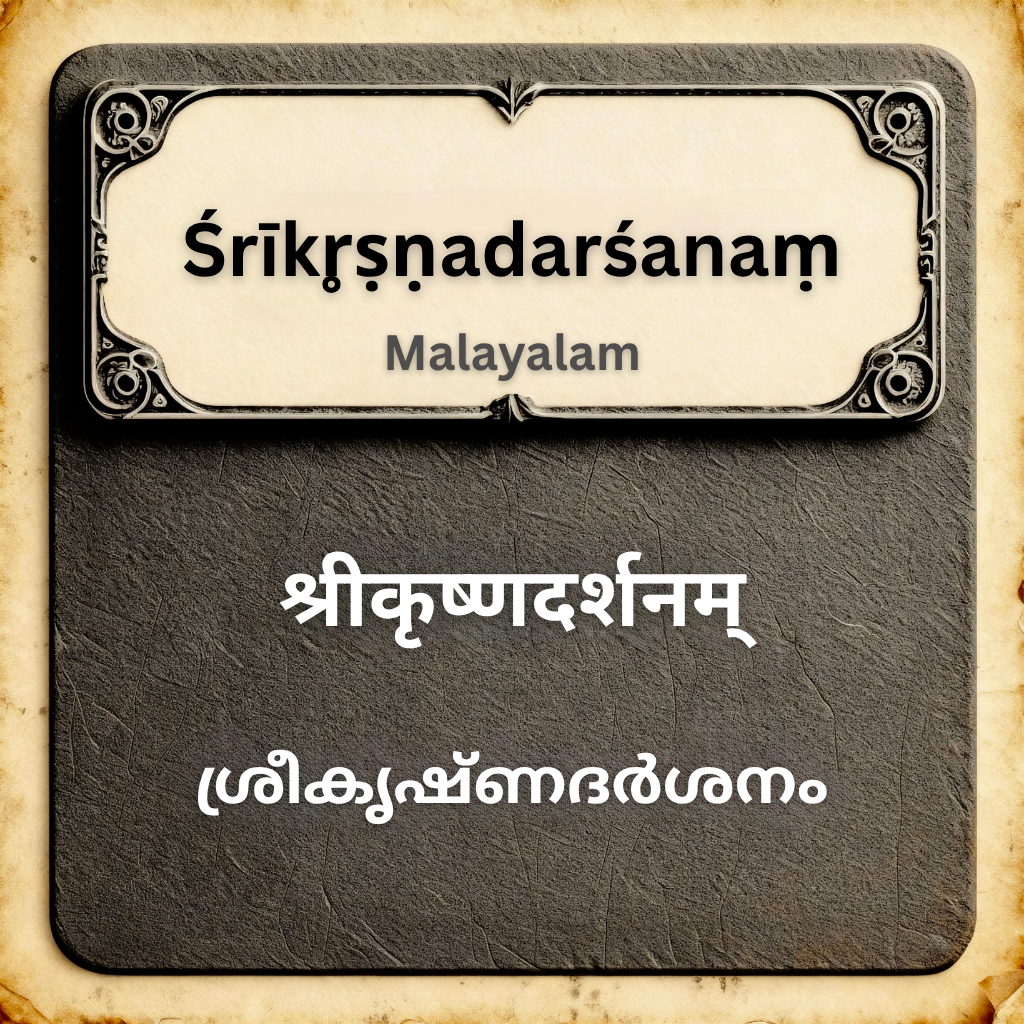
This single verse in Malayalam in the Śārdūlavikṛīditaṁ metre describes the ecstatic vision the author had while being a student at Kayamkulam. He swooned on having the vision and the verse was written afterwards when his mentor asked him about the vision. This apparently is the first work of Guru preserved for posterity.
Nataraja Gurukula
3
Malayalam
Preface
Narayana Guru’s Śrī Kṛṣṇa Darśanam is a rare verse, where language transcends its ordinary bounds to become a window into the ineffable. It is not a description of the divine but an invitation to witness it—direct, unadorned, and pulsing with life.
The imagery here is luminous in its simplicity. A veil lifts, and what was hidden is suddenly, breathtakingly clear: the radiance of Krishna’s form, the quiet glow of the Kaustubha gem, the tender freshness of a flower in first bloom. These are not metaphors to be deciphered but moments to be felt—instants where the boundary between the sacred and the visible thins, then disappears entirely. The poem does not narrate; it reveals, drawing us into a space where seeing becomes knowing.
The rhythm of the verse moves like breath—steady, unhurried, alive. Each word is chosen with the care of a meditation, not to ornament but to awaken. Even in translation (here rendered as faithfully as possible to the original), the music of the lines lingers, a quiet hum beneath the surface. This is poetry as presence, where sound and silence are not opposites but companions, guiding the listener inward.
At its heart, the poem is an act of devotion—not the kind that pleads or praises, but the kind that sees. There is no clamor here, only a deep, abiding recognition: the divine is not distant but here, in the stillness after the world’s noise fades. The speaker does not ask for anything; they simply behold, and in that beholding, we sense a truth too profound for longing—it is already complete.
The structure mirrors this journey. The poem begins with dissolution—the cessation of thought, the merging of the world into pure being—and from that silence, light emerges. The movement is subtle, effortless, like dawn breaking after a long night. Form and meaning align perfectly: just as the veil of illusion lifts in the verse, the poem itself lifts the reader’s gaze, not toward abstraction but toward the tangible, shimmering reality of the divine.
What does it show us? Not a concept to grasp, but a truth to inhabit. The poem speaks of a oneness that is neither earned nor achieved, only recognized—as if remembering something we had always known but somehow forgotten. It does not argue or explain; it simply is, like the flame it describes: unwavering, quiet, and utterly clear.
To read Śrī Kṛṣṇa Darśanam is to be reminded that the most profound truths are often the simplest. They ask only that we pause, look, and let the seeing undo us. May this verse, in its radiant brevity, offer what all great poetry does: not answers, but an encounter—with the world as it truly is, and ourselves as we truly are.
—The Editor
Copyright ©2025 Nataraja Guru. All Rights Reserved.


Comments