
The Many Faces of the Divine
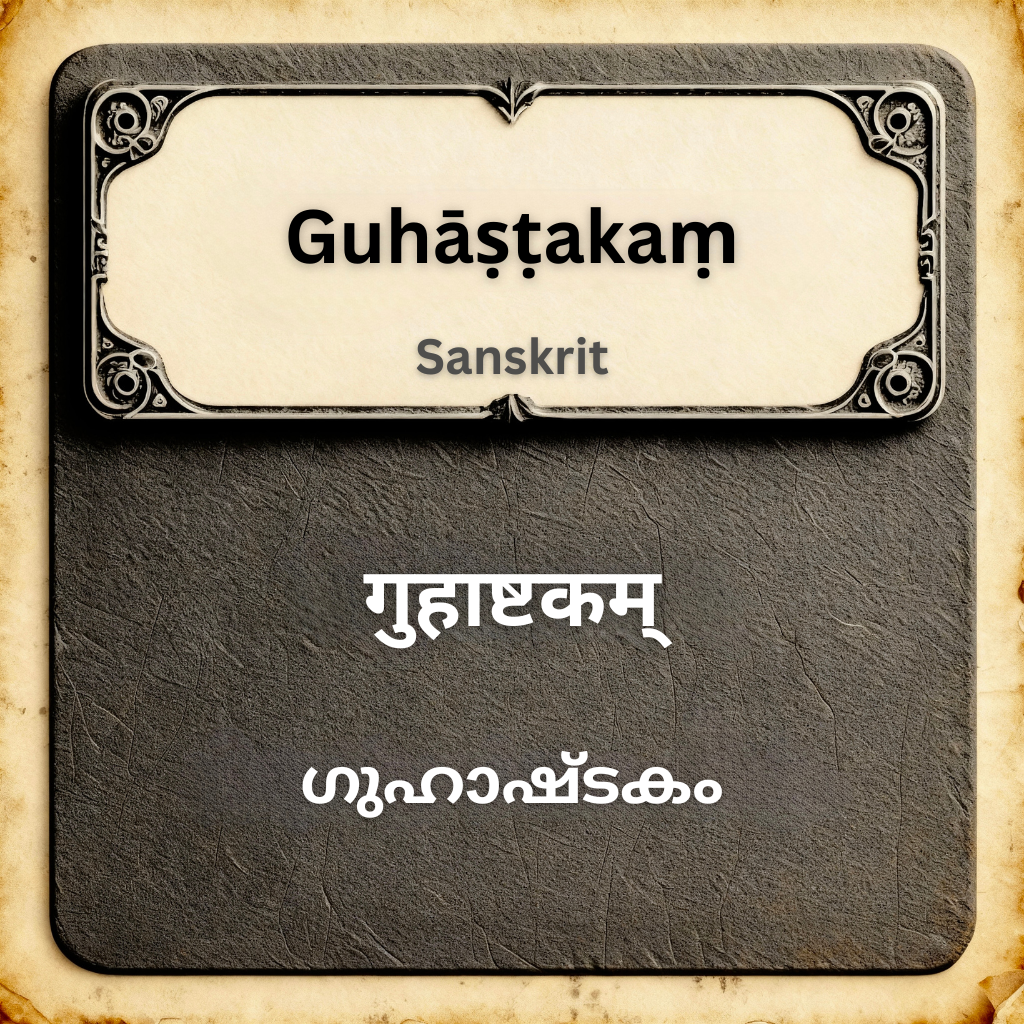
Narayana Guru’s Guhāṣṭakam unfolds like a tapestry woven with paradoxes—each thread a revelation, each contrast an invitation to look deeper. Here, Guha (Skanda) is not a deity confined to myth but a living presence who wears contradictions as ornaments: ashes and jewels, serpents and lotus feet, the roar of a warrior and the hush of infinite stillness. This is not poetry about the divine; it is an experience of the divine in words.
The imagery pulses with life, refusing to settle into simple archetypes. A body “tender as a hibiscus” yet adorned with snakes; a form “saltron-colored” yet radiating “ever-rotating effulgence.” These are not mere descriptions but thresholds, inviting us into a world where the mundane and miraculous share the same breath. The poem’s power lies in its ability to startle—to show us the familiar (ashes, flowers, armor) and make it strange again, luminous with meaning.
Language here is both weapon and offering. The Gīti metre drives the verses forward with rhythmic intensity, while the repetitions—”bow your head,” “God of gods”—anchor us in devotion. Words like “upsurging Bliss” or “elixir-of-Immortality’s waves” don’t just signify; they vibrate, carrying the weight of direct experience. This is poetry as ritual, where sound and sense merge into a single act of seeing.
Devotion in Guhāṣṭakam is neither meek nor grandiose—it is a fierce intimacy. The speaker does not beg for grace; they name Guha’s attributes with the confidence of one who knows: the destroyer of fear, the conqueror of time, the “pearl-necklace on his chest.” There’s a childlike wonder in this litany, as if reciting these truths makes them real. And perhaps it does—for in listing Guha’s paradoxes (attached to nothing, yet bound to all; beyond time, yet “blue spot on his throat”), the poem dissolves the boundaries between seeker and sought.
Each verse builds like a wave, layering qualities without summation. Guha is “one and the many,” “formless” yet with “six faces,” “virtuous” yet unafraid of darkness. The structure mirrors the divine play it describes: endless variations on a theme that can never be pinned down. By the final verse, we’re not left with a definition but a presence—one that lingers like the scent of hibiscus after the flower is gone.
What lingers, beyond the images, is an unshakable truth: the sacred is not opposed to life but hidden within it. Guha’s ashes are not symbols of renunciation but emblems of transformation; his serpent ornaments whisper of wisdom coiled in the ordinary. The poem doesn’t point beyond the world—it illuminates the world itself as the arena of the divine.
To read Guhāṣṭakam is to participate in an ancient act of recognition. Not to “learn” about Guha, but to meet him—in the cadence of the verses, in the spaces between contradictions, in the quiet after the last word is spoken. May this meeting stir you as it has stirred generations: not toward answers, but toward awe.
—The Editor
Copyright ©2025 Nataraja Guru. All Rights Reserved.


Comments